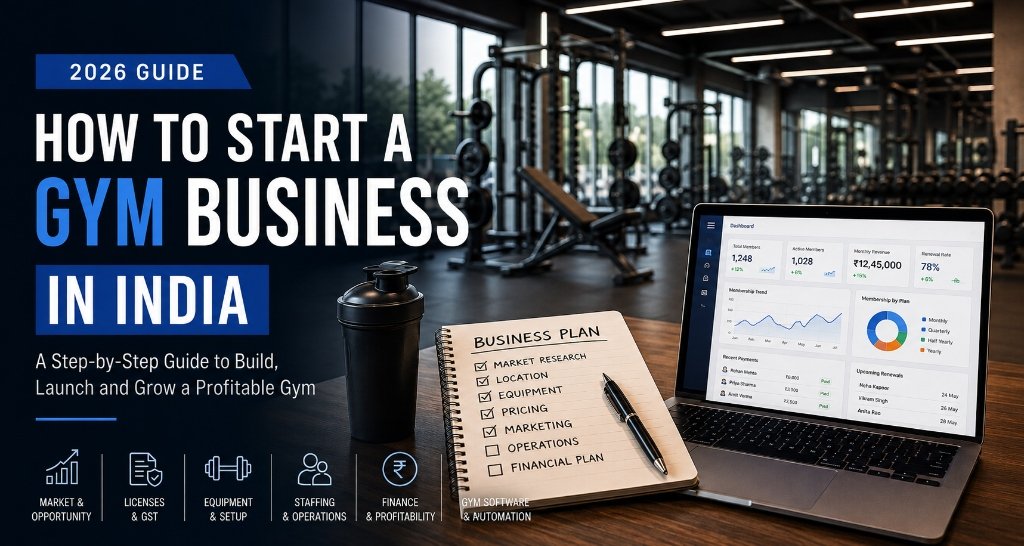
India's fitness industry is no longer a niche. It is one of the fastest-growing service sectors in the country, and it is attracting entrepreneurs who have never run a gym before — engineers, ex-athletes, corporate professionals, and franchise investors alike.
But most people who search for "how to start a gym business in India" find either outdated advice or generic checklists that ignore the real operational and financial complexity of running a fitness business.
This guide breaks the process into clear, practical steps: market research, licensing, GST, location and equipment decisions, staffing, pricing, and the systems you need to run the business profitably from day one.
- Capital & Setup: Investment ranges from ₹15–35L for value gyms to ₹50L–2Cr for premium clubs. Value gyms command 78% of memberships, while boutique studios grow at 19% CAGR.
- GST 2.0 Tax Impact: Fitness services are taxed at 5% GST without Input Tax Credit (ITC). Non-recoverable ITC on capital equipment must be budgeted.
- Break-Even Metric: Determine break-even membership count early (e.g., 267 active members at ₹1,500/mo for a ₹4L fixed monthly overhead).
The Problem: Most New Gyms Are Started Without a Business Plan
Ask most gym owners why they started a gym, and the answer is usually passion — for fitness, bodybuilding, or helping people get healthier. That passion is valuable, but it is not a business plan.
A large share of new gyms in India are opened by first-time owners who:
- Underestimate rent, fit-out, and equipment costs
- Have no clear pricing or membership strategy
- Track payments and attendance manually, in registers or spreadsheets
- Have no system for lead follow-up, trials, or renewals
- Don't separate personal and business finances
- Are unaware of GST obligations until a tax notice arrives
This is why a large number of independent gyms shut down within their first two to three years — not because demand is weak, but because the business side was never built properly.
"A gym is a fitness service wrapped around a business. If the business side fails, the fitness side never gets a chance."
Why This Happens
Three structural reasons explain why gym businesses in India struggle more than the demand data would suggest:
- Low barriers to entry, high barriers to profitability. Anyone with a rented space and some equipment can open a gym. But sustaining 70%+ member retention, managing trainer payroll, and running compliant accounting requires systems most first-time owners don't set up.
- Thin margins in a price-sensitive market. India's fitness market is dominated by value-tier gyms rather than premium ones. Value gyms contribute roughly 78% of memberships and 80% of facilities in India today, which means most operators are competing on price, not just quality.
- Fragmented back-office operations. Membership tracking, trainer scheduling, payments, and accounting are often handled across WhatsApp, Excel, and a physical register — with no single source of truth.
The Market Opportunity: Latest Statistics (2026)
Despite the operational challenges, the underlying demand story is strong.
| Metric | Data Point |
|---|---|
| India's fitness market size (products + services) | Projected to reach $6.58 billion by 2026, growing at a CAGR of 8.9% from 2021 |
| Indian gyms, health & fitness clubs market revenue | $1.9 billion in 2022, with a 16.3% CAGR between 2017 and 2022 |
| Paid gym membership base | Around 13.6 million Indians held paid gym memberships in 2025–2026, growing at roughly 11% CAGR |
| Untapped opportunity | Of India's 956 million people aged 18–62, only about 15% of physically active adults currently pay for fitness services |
| Fastest-growing segment | Boutique studios are growing at nearly 19% annually through 2030, even though value gyms still dominate overall share |
| Market concentration | The top 10 Indian cities generate 56% of industry revenue but hold only 31% of facilities — showing room to expand in emerging cities |
| Global fitness industry | Projected to be worth $278 billion in 2026, growing at 7.9% annually |
What this means for a new owner: demand is real and growing, especially outside the top metro markets, and especially in the boutique and specialized segment (CrossFit, functional training, women-only studios, yoga). The opportunity is not just "open a gym" — it's "open the right kind of gym, in the right location, run properly."
Step-by-Step: How to Start a Gym Business in India
Step 1: Choose Your Business Model
Before you sign a lease, decide what kind of fitness business you are building. This decision affects everything downstream — space size, equipment budget, trainer hiring, and pricing.
| Model | Typical Space | Investment Range | Best For |
|---|---|---|---|
| Budget/value gym | 1,500–3,000 sq ft | ₹15–35 lakh | High-footfall residential or tier-2/3 markets |
| Premium fitness club | 4,000–10,000 sq ft | ₹50 lakh–2 crore | Tier-1 cities, corporate catchments |
| CrossFit/functional box | 1,200–2,500 sq ft | ₹15–40 lakh | Niche, community-driven audience |
| Yoga/Pilates studio | 800–1,500 sq ft | ₹8–20 lakh | Lower equipment cost, wellness-focused clients |
| Franchise gym | Varies by brand | ₹40 lakh–1.5 crore + royalty | Owners who want a proven system and brand recall |
Step 2: Research Your Local Market
Don't assume demand — validate it. At minimum:
- Map competitor gyms within a 2–3 km radius and note their pricing, hours, and crowd type
- Check residential density, office clusters, and footfall patterns nearby
- Survey 30–50 potential customers on what they'd pay and what's missing in existing options
- Identify whether the area is under-served in a specific segment (women-only, senior fitness, CrossFit, budget)
Step 3: Write a Simple Business Plan
Your plan doesn't need to be 40 pages. It needs to answer:
- What is your membership pricing structure (monthly, quarterly, annual)?
- What is your break-even member count?
- What is your monthly fixed cost (rent, EMI, salaries, utilities)?
- What is your customer acquisition plan for the first 90 days?
If your fixed monthly cost is ₹4,00,000 and your average membership fee is ₹1,500/month, you need roughly 267 active paying members to break even — before profit. This single number should guide your location size, marketing budget, and pricing decisions.
Step 4: Register Your Business and Get Licenses
Most gym owners in India operate as a sole proprietorship, partnership, or private limited company, depending on scale and investor involvement. Required registrations typically include:
- Business registration (proprietorship/LLP/Pvt Ltd, based on your structure)
- Trade license from the local municipal corporation
- GST registration (mandatory once turnover crosses ₹20 lakh, or ₹10 lakh in special category states)
- Fire safety NOC, particularly important given equipment density and electrical load
- Shops and Establishment Act registration
- Professional tax registration for staff, where applicable
- Music license (if you play licensed music during classes) from a PRO like IPRS or PPL
Step 5: Understand GST for Gyms (2026 Update)
GST compliance is one of the most commonly mishandled parts of running a gym in India, and the rules have changed recently.
- Under GST 2.0, effective 22 September 2025, gym membership fees, personal training, and fitness services are taxed at 5% GST, down from the earlier 18% rate.
- This 5% rate applies without Input Tax Credit (ITC), meaning gyms cannot offset GST paid on rent, equipment, or fit-outs against the GST they collect from members.
- Gym equipment itself, along with branded merchandise and packaged supplements sold in-house, may still attract separate GST rates ranging from 12% to 18%, depending on classification.
- Freelance or independent trainers must also register for GST and charge it once their turnover crosses ₹20 lakh (₹10 lakh in special category states).
Practical takeaway: Build GST into your pricing from day one — don't treat it as an afterthought added at billing time. And because ITC isn't available on the reduced rate, factor the full, non-recoverable GST cost of your equipment and fit-out into your capital budget.
This is a summary for planning purposes only — always confirm current GST rates and applicability with a qualified CA before finalizing pricing, since rates and rules are subject to revision.
Step 6: Select and Fit Out Your Location
- Prioritize ground floor or easily accessible upper floors with a separate entrance
- Ensure ceiling height of at least 10–12 feet for equipment like power racks and cable machines
- Plan for adequate electrical load (3-phase connection is often necessary for AC and cardio equipment)
- Budget for flooring (rubber matting), ventilation, mirrors, and changing rooms separately from equipment cost
- Negotiate a lock-in period that matches your break-even timeline — don't over-commit before you've validated demand
Step 7: Buy the Right Equipment (Not the Most Equipment)
New owners frequently overspend on equipment variety before validating what their specific member base actually uses.
Practical approach:
- Start with a core set: multi-station machines, free weights, cardio equipment, and functional training tools
- Buy commercial-grade equipment, not home-use equipment — it's built for higher usage cycles
- Consider a mix of new and certified refurbished equipment for non-critical stations to control initial capital outlay
- Leave 15–20% of your equipment budget unallocated for the first 3 months, so you can add what members actually request
Step 8: Hire and Certify Your Team
Your trainers are your product as much as your equipment is. At minimum:
- Hire trainers with recognized certifications (NASM, ACE, K11, or equivalent)
- Have a clear SOP for onboarding new members — assessment, goal-setting, and a structured first month
- Decide your staffing model early: fixed salary, commission-based, or hybrid
- Include front-desk/membership staff in your budget — many owners underestimate this cost
Step 9: Set Up Your Pricing and Membership Structure
Avoid single-tier pricing. A layered structure captures more of the market:
| Tier | Example Offer | Typical Price Point |
|---|---|---|
| Basic | Gym floor access only | Lower end of local market |
| Standard | Gym + group classes | Mid-range |
| Premium | Gym + classes + personal training sessions | Higher end |
| Trial | 3–7 day trial via QR code or referral | Free or nominal fee |
Step 10: Set Up Systems Before You Open, Not After
This is the step most first-time owners skip — and it's the one that determines whether the business survives past year two.
Before opening day, you should have a working system for:
- Membership sign-up, renewal, and freeze/cancellation tracking
- Trainer scheduling and payroll
- Daily attendance and check-in
- Payment collection and GST-compliant invoicing
- Lead capture and trial conversion tracking
- Basic profit-and-loss visibility, updated monthly, not annually
Best Practices for a Sustainable Gym Business
- Track retention, not just sign-ups. A gym that signs 100 members and loses 40 within 3 months is worse off than one that signs 60 and keeps 55.
- Automate renewal reminders. Manual follow-up is the single biggest cause of preventable churn.
- Separate business and personal accounts from day one. This alone prevents most of the tax and compliance headaches gym owners face later.
- Review your GST filings monthly, not just at year-end — errors compound quickly in a cash-heavy business.
- Use QR-based trial management instead of paper trial forms — it's faster to convert and easier to track conversion rates.
- Review trainer utilization monthly. Idle trainer hours are a direct hit to profitability.
A Simple Pre-Launch Checklist
Common Mistakes New Gym Owners Make
- Underpricing to "beat" competitors. This erodes margins and makes it harder to invest in retention later.
- Ignoring GST until the first filing deadline. This often leads to penalties and messy backdated corrections.
- Over-investing in equipment before validating demand. Buy the core, expand based on actual member requests.
- No formal onboarding for new members. Members who don't see progress in the first 30 days are the most likely to churn.
- Manual, disconnected record-keeping. Attendance in one register, payments in another app, and accounting in a separate spreadsheet — this makes it nearly impossible to see real profitability.
- No system for multi-location tracking, if expansion is part of the plan. Owners who open a second location often duplicate the same manual chaos instead of fixing it.
Expert Tips
- Price for value tier, but design for retention. Since value gyms make up roughly 78% of memberships in India, competing purely on price is common — but the gyms that survive combine competitive pricing with strong onboarding and community, not price alone.
- Look beyond tier-1 cities. Top-10 cities generate the majority of industry revenue but hold a minority of facilities, suggesting real headroom in tier-2 and tier-3 markets with lower rent and lower competition.
- Treat boutique formats as a growth lane, not a niche. Boutique studios are growing close to 19% annually — a specialized CrossFit box or yoga studio can often out-earn a generic gym per square foot.
- Build financial discipline early. Double-entry accounting from day one — even for a small single-location gym — makes tax filing, investor conversations, and expansion decisions far easier later.
How ActivSaga Fits Into This
Most of the "systems" step above — membership tracking, GST-compliant billing, trainer scheduling, lead and trial management, and real-time financial reporting — is exactly where new gym owners lose time and money to manual processes.
ActivSaga is built as an operating system for fitness businesses, not just a membership tracker. It brings memberships, payments, double-entry accounting, GST invoicing, staff management, QR-based trial tracking, and multi-location reporting into one system, so an owner can see actual business performance — not just attendance numbers — from day one.
- ✓ GST-compliant invoices generated automatically at the correct rate
- ✓ One dashboard for membership status, renewals, and churn risk
- ✓ Trainer scheduling and payroll linked to actual attendance
- ✓ QR-based trial sign-ups that convert into tracked leads
- ✓ Accounting reports (P&L, balance sheet) available without separate bookkeeping
- ✓ A single view across locations for owners planning to expand beyond one gym
Conclusion
Starting a gym business in India in 2026 is a genuine opportunity — the market is growing, membership penetration is still low relative to the population, and demand outside major metros is largely untapped. But the businesses that survive past year two are the ones that treat the gym as a business first and a fitness passion second.
Get the fundamentals right before opening day, and the fitness side of the business has a real chance to grow.
Frequently Asked Questions
Costs vary widely by format and city — a small budget gym can start around ₹15–35 lakh, while a premium fitness club can require ₹50 lakh to ₹2 crore, depending on location, size, and equipment quality.
Yes, once your annual turnover crosses ₹20 lakh (₹10 lakh in special category states), GST registration is mandatory. As of GST 2.0 (effective September 2025), gym and fitness services are taxed at 5% GST without Input Tax Credit.
At minimum: business registration, trade license, GST registration, fire safety NOC, and Shops and Establishment Act registration. Requirements can vary slightly by state and municipality.
Value gyms currently hold the largest share of memberships and facilities, but boutique formats like CrossFit, functional training, and specialized yoga/Pilates studios are the fastest-growing segment and often deliver stronger margins per square foot.
It's not legally required, but manual tracking of memberships, payments, and GST invoicing becomes unmanageable quickly. Most owners find that adopting a system early saves significant time and prevents compliance issues.
This depends entirely on your fixed costs and pricing. Divide your total monthly fixed costs (rent, salaries, EMIs, utilities) by your average membership fee to get an approximate break-even member count.